Avoid Injuries From Safes: Part 4

Ironically, immediately after my last post, we got in a used commercial safe with a history of injury.  And it came from the same restaurant chain to which I referred in that last post.

Slam damper 003Slam damper 009

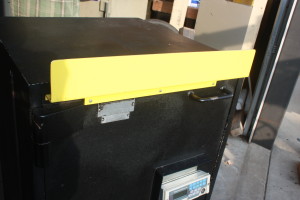
Some years ago, AFTER an employee lost a finger in this safe, it was fitted with three safety devices to prevent additional accidents.  1)  The photo on left shows the slam damper that was installed, which keeps the door from slamming on someone’s hand.  (I know the photo in the last post was poor.)  2)  In the other photo, you can see a push/pull handle.  When using this handle to close the safe your fingers are not near the edge of the door.  3)  That picture also shows the yellow figure guard.  This piece of steel extends up 3” above the edge of the door, again, to keep fingers from getting pinched as the door is closed.

My guess is that the cost of installing these three items was much less than the business ended up paying for the severed finger!

Avoid Injuries When Working With Safes: Part 2

Incorrect placement of your safe, especially a tall unit, can cause a real safety issue.

Many years ago a new employee set up a 700# gun safe in our showroom on pieces of 4” x 4” wood.  The wood was pushed back about 5” from the front edge, making the safe unstable.  That night I was working alone and opened the door of that safe to check it out.  It fell forward as the weight of the overhanging door moved the center of gravity beyond the wood.  It caught me by surprise and I did not react quickly enough.  The outside corner of the door hit the floor hard enough that the door was pushed up and off the hinge pins so that it fell on me knocking me to the ground.  With a major effort I pushed the door aside and off of me, but then the safe body came down with even more force.  Luckily there were no injuries.  I was able to get out from under it rather than be trapped until the next day, but it could have literally killed me.

A recent customer brought this incident to mind.  He bought a high-security plate steel safe which measured 72”h x 40”w and weighted 2700#.  He drove it home himself on a flatbed and was able to lower it into his basement while remodeling his home.  Woodworking is his hobby so he built it into place in a cabinet with a deep toe-kick area.  Guess what happened when he opened the door!! He was extremely fortunate because the door was at exactly 90 degrees when the door hit the floor, and the hinges stayed intact.  Because the center of gravity was very close to the edge of the support he was able to push it back into place.  He could easily have been crushed.

Tall, shallow gun safes may be especially unstable.  Putting them on a thick carpet makes matters worse and they can fall forward when the door is opened.  Without thinking about it, a minor action like resting your hand on the open door can make the difference that causes an accident.  It is best to bolt these safes down to the floor for stability.  Adding lots of weight inside (say, 200# of silver) will help, too.

When placing a safe make sure it is resting on solid support right out to the front edge of the safe, and bolt it down if there is any chance it is not stable.

Avoid Injuries When working With Safes: Part 1

Moving safes can be dangerous.  You should not attempt to move large units, like gun safes, unless you have experience with this kind of task.  It is not uncommon for people to be injured when moving a safe.  We are occasionally called to stand up a safe that has fallen over when it was being handled by inexperienced people.  Usually, their new safe is now scratched up and ugly.  Frequently it also then needs to be professionally drilled open and have a new lock installed.  The safe on which they “got a good deal” has now cost them dearly.

Several tips for moving a heavy safe:

1)  Having too many people around can cause distractions, increasing the likelihood of accidents.

2)  Take lots of time to think through all the issues and risks – hurrying can cause accidents.

3)  Rolling a safe across the floor on golf balls sounds like a good idea, but has been the cause of many accidents.  Trying to slide a safe on blocks of ice is really dangerous.  Use pipes instead.

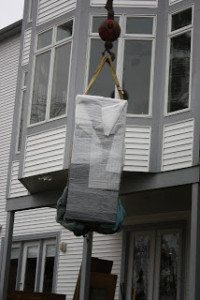
4)  When moving a safe by pallet jack, forklift, crane, etc., be alert and stand far enough away that the safe cannot possibly reach you if it falls.
CRANE LIFT 051 (427x640)

5)  If the safe wants to fall, especially a tall one, don’t be a hero.  Don’t try to stop it, let it fall.  Paying to have it repaired is cheaper and less painful than broken bones.

6)  We normally advise not taking the door off to lighten the safe.  Dropping the door on your foot could cause a serious injury.  A heavy, tall, awkward safe door can catch you off guard and knock you over.  (You will probably also damage the paint trying to put the door back on its hinges.)

7)  When taking a heavy unit downstairs be EXTREMELY CAUTIOUS.  Consider standing at the top of the stairs and slowly lowering it with straps.  Consider reinforcing the staircase from underneath.

8)  Best advice:  Pay to hire professionals.

Too many people are injured, or damage their safe, or damage their home when doing work they should not attempt.  Buy you safe from a dealer that offers delivery service.

The Best Way to Install a Safe

We are frequently asked whether it is best to install a safe flat on the floor or to raise it up off the floor to provide air circulation.  Since each method involves trade-offs, the “Best” method depends on your situation and your primary concern.

If security is the only issue the safe should be flat on the floor, bolted down.  But won’t that cause rust and stain the floor if there is no air circulation?  Very possibly, depending on the type of floor and how well the bottom of the safe is primed or painted.  Most residential safes are primed, but some companies do a poor job of it.  Sliding the safe across rough surfaces will scrape off primer, making rust more likely.   The primer itself may stain.  So just make the assumption that the floor will get stained.  Then decide whether the potential of burglars removing your safe is more important than the risk of a discolored floor.

If the safe is going into a basement which has a history of water problems, I recommend elevating it on 4” x 4” or 4” x 6” wood.  Putting the safe on concrete blocks will lift it even higher.  These arrangements will be functional but they won’t look great.  IMPORTANT:  When elevating a safe make sure it is supported right out to the front edge or the safe may fall forward when the door is opened!  This is especially true with tall units like gun safes.  Note that raising the safe makes bolting it down pointless — the open space allows pry bars or pallet jacks underneath which can pull the bolts right out of the floor.  We often use hockey pucks or thin strips of wood to create a ventilation space underneath.  Hockey pucks even look good.  But this small space makes a great home for mice and bugs.

Blog, Install safes 002Blog, Install safes 004

Finished hardwood floors are easily scratched when maneuvering a safe into place.  Here are two things that work out well:  Put the safe on a piece of up-side-down carpet, soft side to the floor.  The safe will slide easily into place and it won’t scratch the floor.  Four thick felt pads under the safe will accomplish the same thing.  But be careful using pads because some safes are bowed on the bottom and the middle might still scrape the floor.

f you are not concerned about someone removing your safe, and you do not want the floor stained, and you don’t want to create a home for small critters, and you want it to look nice, buy a 4” high carpeted pedestal.  We sell them for $70.

Relock Devices: External Relockers

External relockers are located outside the lock body, but usually right next to it, inside the safe door. The external relocker stops the transfer bars from moving, so that the safe bolts cannot be forced back by a burglar into the unlocked position. Two variations of the most common arrangement are shown below.

External Relockers 002External Relockers 005


If someone pounds on the dial enough so that the dial spindle drives the lock or lock cover backward, then it releases the spring-loaded relock bolt.  On some safes (picture on right) it will block the cam from moving by dropping behind the cam or into a notch on the cam.  Safes that use gear drives rather than cams will be different.  On the gear drive Fort Knox on the left , the relock bolt goes behind a block welded to the transfer bar.  Some safes have a notch in the transfer bar into which the relocker goes.  A qualified safe technician will be required to open a safe after an external relocker has been set off.

Interesting note:  The safe on the right is a popular brand that we will not sell, and the relocker is not assembled properly.  The lock cover plate is installed so that the roll pin rests on top of it, rather than being fit into a hole in the plate where it is supposed to be.  I guess it takes too long to make the parts fit correctly.

When buying a safe make sure it has an internal relocker.  Most cheap safes, especially Chinese made safes, do not have them.