Call a Safe Tech to Open a Locked Safe

This low end gun safe was being used in a pharmacy (wrong safe for the application).  When the cheap lock failed the owner called a local locksmith to open it.  For some reason the locksmith started out by drilling six holes in the left side, and when that did not work he cut a large hole in the door to remove the lock.  We were called to repair it, but the cost to repair and make it presentable was more than the safe was worth.  How would you like to pay this locksmith’s bill for destroying your safe?
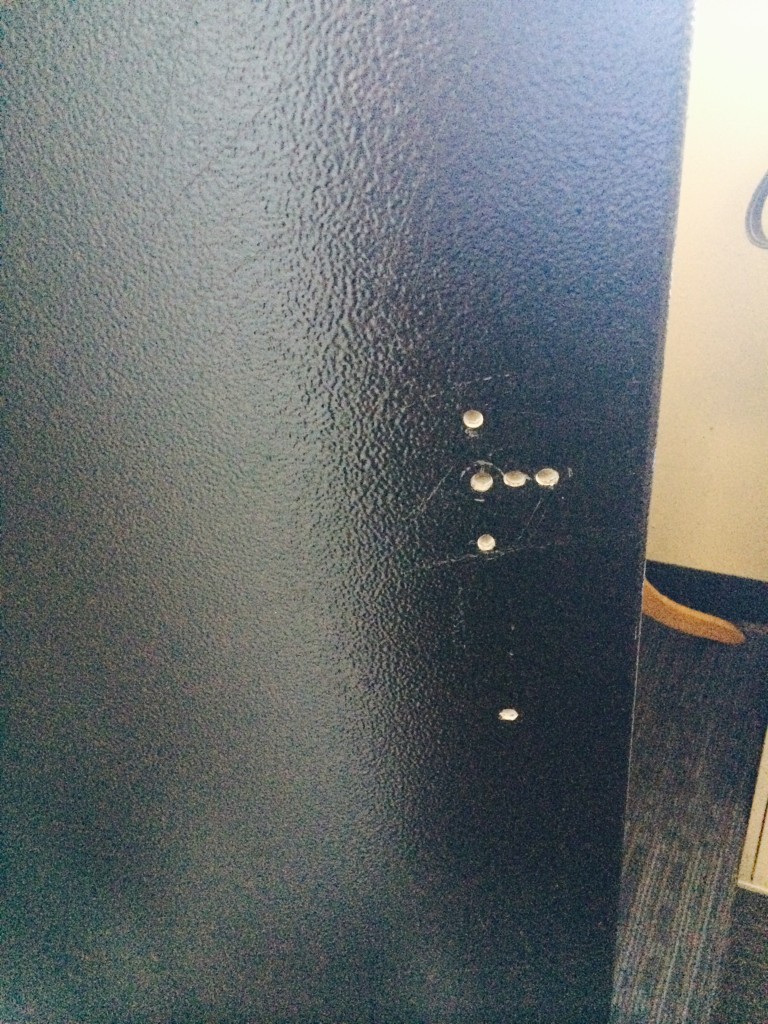
photo_2   photo

If we had been called first we would have opened the safe without drilling it at all, or by drilling one hole behind the keypad where it wouldn’t show.  Calling the right technician first would have avoided:

  • Needing to buy a new safe
  • The hassle of removing and disposing of the old safe
  • The hassle of moving in a new unit
  • Wasting time to clean up the mess left by the locksmith

When you need a safe for your business, don’t go to a box store — go to a safe store where they carry appropriate safes.  When you have a safe problem, anywhere in West Michigan, call a properly trained safe technician, not just a locksmith.

Why a Safe Lock Quits Working Gradually

Here is a call we often get that drives me crazy:  “My safe quit working today and I can’t get it open.  The lock started acting up about four months ago and kept getting worse, but now it won’t open at all.”  The safe now needs to be drilled open and they complain about a bill of $300 to $400.

spline keys 012spline keys 002

The most common reason a combination lock goes bad gradually, and then fails completely, is a loose “spline key”.  When you turn the dial on a good combination lock a spindle transfers that movement to the lock body which is mounted on the inside of the door.  Three or four wheels and some other parts are held in place on the spindle by a tiny L-shaped spline key, pictured on left.  The other photo shows the inside of a Group 2 lock.  At the center of the “drive wheel” is the spindle.  It is grooved to hold the spline key (here pointing to 10:00) that in turn unites the wheels to the spindle.

When the spline key gets loose the wheels move, so they are no longer in sync with the dial.  The lock will not open consistently even when dialed accurately.  Keep trying to use the lock and the spline key will loosen up more, until it hits the inside of the lock cover or it falls out completely.  In either case you are locked out of your safe.

When your safe acts up, don’t put it off.  Avoid paying to drill it open by calling a competent safe technician immediately when you have problems.

The Best Batteries for Electronic Safe Locks

We get this phone call every day:  “My safe has an electronic lock and I have changed the batteries but it still won’t open.”  Usually the problem is that they put in cheap batteries.  Yes, there is a difference.

J BAWM & VULCAN 007

Whether the lock is on a fire safe, commercial safe, gun safe or vault door, the ONLY batteries that will consistently work electronic safe locks are Duracell and Energizer alkaline.  Store brand batteries and even the other famous brands are inferior.  The voltage will be the same on most of them, but the amps will be higher on Duracell and Energizer. Electronic safe locks need high amps to work properly. Use batteries that are fresh from the store, not the ones that have been sitting in that kitchen drawer for six years.  Don’t use rechargeable batteries, either.

One more word of advice:  Be really careful when changing batteries on electronic safe locks so you don’t break the contacts or connecting wires.  That will require the help (and the fee) of a safe technician.

Gun Safes at SHOT Show

Two weeks ago I attended the Shooting, Hunting and Outdoors Trades Show in Las Vegas.  Most attendees of SHOT are there for the guns, ammo, knives and other cool outdoor gear.  I go to see what is new with gun safes.

One of the things I discovered this year was that some of the sellers of Chinese-made safes know almost nothing about what they are selling.  Visiting with the folks selling Chinese safes I made it a point to ask whether their safes had a lock system with a real lock body or just a solenoid plunger.  Most were puzzled by the question and did not know the difference.  I would get referred to someone else, who sometimes referred me to another person.  They would question back “what difference does it make?”  After a short explanation, it was suggested that they should read what I posted on my previous blog post ($700 Gun Safe).

People selling safes are asking customers to trust them with protection of their most prized possessions.  Doesn’t it make sense, then, that the sellers should actually build in a reasonable amount of security?  Shouldn’t they at least know what kind of lock it has?  Buy American!!

$700 Gun Safe — What Can You Expect?

People always point out to me that they can buy a gun safe at box stores for $700. “There can’t be that much difference between the one for $700 and the ones you sell for more than twice the price,” they say.  Well, today we got in another one of those $700 gun safes.  It is the third one brought in to us in the last three months with failed locks.

Note:  Bringing these safes in is not that hard for the customer because they only weigh about 300#.  Lack of steel y’know, makes for light safes.  Note #2: Almost every $700 safe is Chinese made junk.

External Relockers 003JANUARY 2015 004

The picture on the left is from an American made real safe, which offers real security.  You can see the S&G Group 2 lock which has the internal relocker.  You can see the external relocker next to it.  Behind the lock is the heavy steel mounting plate, which holds in place the ball bearing hardplate to keep someone from drilling into the lock.

Now look at the picture on the right showing the electronic locking arrangement on the $700 Chinese made gun safe.  (The all-American name on the front of the safe is a well-known one that you would recognize.)  See the lock body?  No, there isn’t one – just a solenoid with  .305” diameter plunger.  No internal relocker, either.  Or external relocker.  Or mounting plate.  Or hard plate.  Sometimes people accidentally ruin this solenoid mechanism just by putting pressure on the safe’s spoke handle when the safe is closed.

So how did our safe technician open this “safe” when the lock failed?  High powered drills or expensive specialized equipment?  No, he took off the keypad on the front of the safe.  A piece of wire about twice the thickness of a coat hanger was bent in a particular way, then run through the hole which is there for the lock cable.  Without even being able to see through the hole he used the wire to punch in the solenoid plunger.  You don’t need hammers, screwdrivers, drills, scopes or anything except the wire.  By the way, all three of these which have come to our shop in the last two months failed between 12 and 15 months after purchase, so – you guessed it – they are off warranty. And THAT is what you get when you buy a $700 gun safe!  So spend more money and buy your gun safe (or a vault door) from a safe store.