Fire Rated Safe Saved Family’s Life Savings

The Hercules fire safe shown here in pictures was sold by Hoogerhyde Safe decades ago. It is really filthy and smelly right now because it just went through a bad house fire. It is small, 12 x 14 x 12, a light duty one-hour fire rated unit.  With little burglary resistance, it is not the kind of safe that a person should put much value into, but our customer had his family’s life savings in it – lots of cash.

Blog, Safe from Fire 001 Blog, Safe from Fire 005

The fire was severe so the customer was afraid that his savings were gone. When we got his safe open he was ecstatic to find that everything had survived. He now has an emotional attachment to this safe so he wants it cleaned up and the lock repaired. His family’s life savings should go into a safe with higher security. If his safe had been discovered by a burglar rather than being burned in a fire there would probably be nothing left to protect. His retirement would take a dramatic turn for the worse.

Too many people will use a safe like this inappropriately. For protecting large amounts of cash or other valuables, buy a safe with burglary deterrence in addition to a good fire rating.
Vault Doors & Vault Room Ventilation, Part 2

There is a basic contradiction with vault rooms: You need them to be air tight in case of a fire, but you also need them to have good air quality the rest of the time. How do you accomplish both goals?

  • It is absolutely critical that you buy a vault door from a reputable manufacturer like Fort Knox, Graffunder or American Security who is telling you the truth about their product. There are very few doors that have ever been tested for fire resistance because of the high cost of testing. So almost every manufacturer who claims to have a 1, 2 or 3 hour “fire rated” door is starting out by lying to you. Equating several layers of drywall on the inside of the door with a “fire rating” is just plain bogus. Most of the heat and smoke pass through between the door and frame. If the door does not seal tight all the time it will not be effective at keeping out heat and smoke. Just putting on one or two heat expanding seals won’t do the job either.

I am certainly not an expert in this area, but following is basic information on fire and smoke dampers:

  • Fire dampers protect against fire spreading through ductwork or other access points into a room. My understanding is that the most common and cheapest fire dampers are controlled by thermal links. A piece of metal melts (or somehow changes position) at a relatively low temperature which allows a spring to quickly close the damper. It seems to me that if a thermal link is used at the opening to the vault, lots of heat would already have passed into the room before the damper closes. There are other methods of control.
  • Smoke dampers keep smoke from spreading through ductwork or other openings. They are usually controlled by electric, pneumatic or spring loaded actuators.
  • There are also combination fire and smoke dampers.
  • Dampers can be round or rectangular, as small as 4” x 4”. Use products that have been tested by U. L. for air leakage.
  • Greenheck, Metal-Fab and Ruskin are among the damper manufacturers; I found the folks at Ruskin to be very helpful.
  • Dampers/actuators can be connected remotely to fire alarms, smoke detectors, humidity monitors, etc.
  • For maximum protection inside your vault room, if money is no object: A blower outside the home, or a plenum fan, could force air into the vault room in case of fire. Pressurizing the room will prevent smoke and heat infiltration through the door, vent openings, etc.

Now, about buying a quality, American made vault door from an honest dealer, the best thing to do is call Hoogerhyde Safe.  We can deliver it locally or have it shipped anywhere in the country.

Vault Doors: Ventilation/Air Quality in Vault rooms

Buyers of vault doors frequently ask what they should do for ventilation inside their vault room.  Ultimately, that should be decided by the builder and HVAC contractor.  I am not an expert on this, but here are basic guidelines from my perspective, geared toward starting the thought process:

  • Plan for ventilation issues in advance of building.  These issues are more difficult for a vault room than for inside a gun safe.
  • A dehumidifier should be run inside the vault room for at least a year or two following construction. I am told that concrete gives off moisture for at least a year as it cures.
  • Long term it is best to run a dehumidifier in the vault room to protect your guns from rust unless you are absolutely certain that the HVAC system provides very good airflow and that it keeps humidity low. It would be ideal to put in some type of humidity monitoring device.
  • If there is no ventilation in the room, it will be stuffy, maybe smelly, and you may develop a mildew problem.
  • It is best to have heat and AC ducted into the room (rather than rely only on passive vents) to force air exchange.  Addition of a passive vent out will make for better air flow.
  • A motorized vent like in the bathroom, to outside the house, connected to a timer, is another way to achieve ventilation.
  • If you plan to work on guns in your vault room – clean them, blue them, etc. – it is absolutely necessary to have good airflow to prevent buildup of dangerous chemical fumes. Install a fan that blows out through the vault door, or through a wall vent to the outside of the home. Wire the fan directly to the light switch so you don’t forget to turn it on.
  • You will need extra ventilation if you are lucky enough to have an underground shooting range, or if you are setting up a “man cave” where you and your friends will watch TV, play cards, drink, smoke, etc.
  • Temperature and humidity requirements may be different for vault rooms which are intended for wine collections, stamp collections, sports memorabilia, etc.  Check with experts in your field of collecting.

OK, so if you need good ventilation in there, how do you keep out heat and smoke in case of fire?  Next post . . .

Three Vault Doors: Unusual Application

Last week I visited a customer’s job-site, curious about why he wanted THREE high end in-swing vault doors in his new home.  What I saw would make every “gun guy” envious.

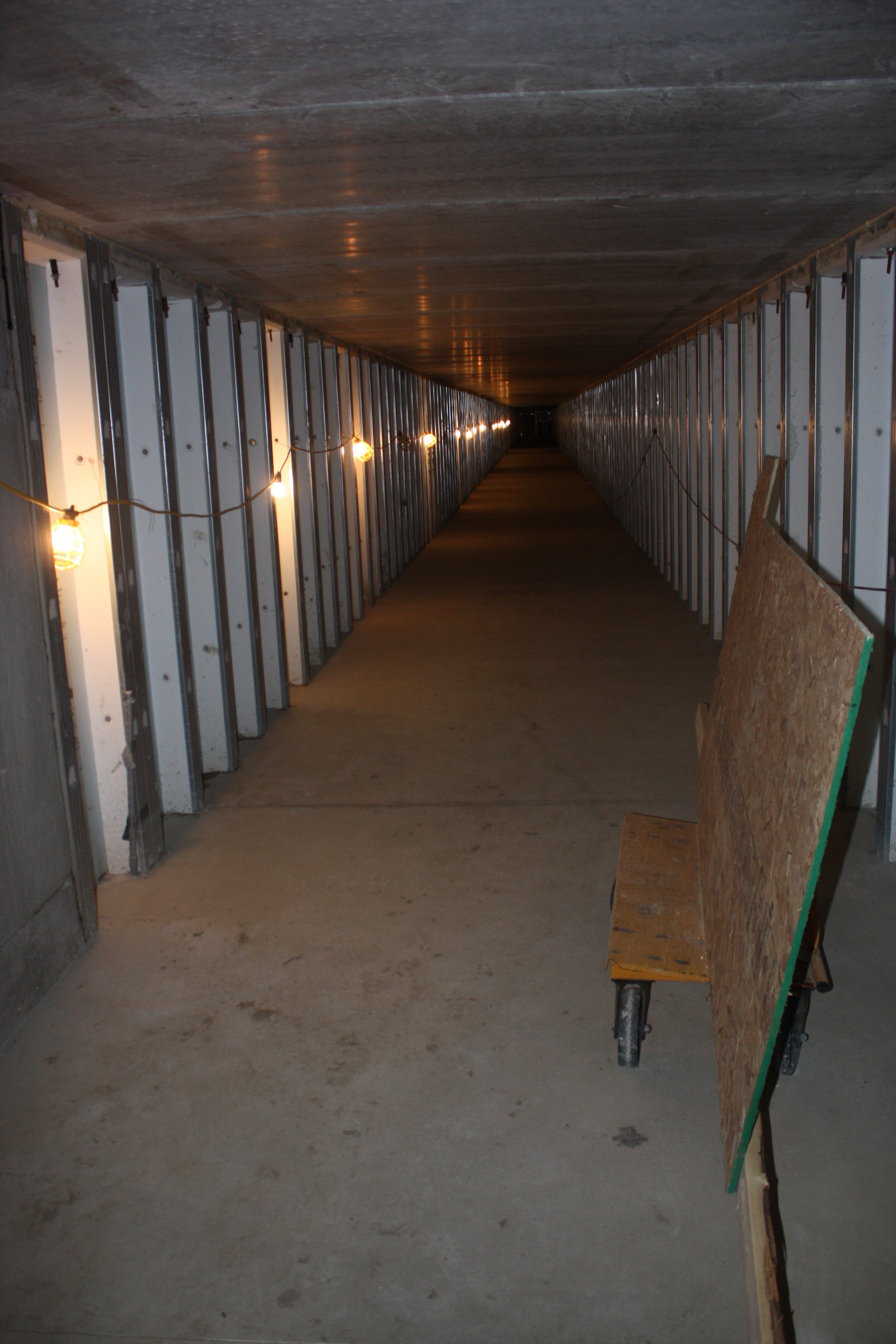
One vault door allows you to enter a combination wine cellar / secure room.  The other two, however, are on opposite ends of a 110 yard underground shooting range!!  From inside the house you go down stairs to a vault door, but open the door and you enter a very long 9’ by 9’ concrete tunnel with in-floor heating and appropriate ventilation. When finished it will have sound attenuation, shooting benches, gun racks and a state-of-the-art bullet catching system.  This guy likes to shoot!

underground shooting range
underground shooting range project

Exit through the vault door at the other end of the tunnel and stairs take you into the “toy barn” where cars, tractors, boats and other fun stuff will be kept.  I am really jealous!

If you have a cool or unusual vault door application please let us know.

Antique Safes: San Francisco Tea Company

Antique safes can be interesting and fun, and they offer a little glimpse into our history.  They also make great conversation pieces in the home or office.  Unfortunately, the exteriors of many have been painted over, like the Mosler Brahnamn which is the subject of this post.

ANTIQUE SAFES & HUMIDOR 002 ANTIQUE SAFES & HUMIDOR 007

A customer got this old safe from an abandoned building.  The combination was unknown so it needed to be opened.  While the original outside paint in covered up, the interior is still very cool. In about 1885 the San Francisco Tea Company must have paid top dollar for this safe with all the extra decorations.  Check out the great paintings inside.  In particular, look at the well-dressed Indian chief.  Doesn’t he look rather European for a Native American?

Nice antiques are getting hard to find, and going up in price.  If you are seriously interested in getting an antique safe, email us with information on the size you want as well as price range.