Coolest Gun Safe on the Market, From Fort Knox

Fort Knox Safes is famous for allowing the consumer to customize the gun safe he wants.  This year Fort Knox introduced two more options that offer cool new looks, more ways to get your gun safe your way.

Old, very retro industrial design is fashionable.  This is especially true where old factories and warehouses are being converted into desirable apartments and condos.  Fort Knox’ new “Distressed Industrial” finish fits right in.  Each gun safe is different with the addition of big rivets and random distress marks to the paint.  Besides rehabilitated industrial buildings these units look good in your work shop area or man cave.

DISTRESSED 4 002DISTREESED FINISH 006

The other terrific new option is Fort Knox’ crane hinge.  This is also a throw-back to the old days.  A hundred years ago very heavy safes and vault doors were frequently built with crane hinges to help the doors move more freely.  This system makes safe doors that are actually double-hinged, so they move in a more three dimensional manner.  Crane hinges are available on all Fort Knox gun safes (except Mavericks) and in all finishes.  D6031 and D7240 shown.

If you want to really impress your friends — and get serious security at the same time — get a Fort Knox gun safe or vault door with the new Distressed Industrial finish and crane hinges.  Awesome!

TL Rated High Security Gun Safes

Customers that do research in order to find the best gun safe on the market sometimes decide they need a “TL” rated gun safe.  But while they find all kinds of units with Residential Security Container (RSC) ratings, they cannot find any TL’s.

Very few gun safes qualify to carry TL ratings.  You are basically buying a jeweler quality safe with a gun rack interior.  Here are the reasons most manufacturers do not offer them:  While buyers like the idea of getting a high security unit, few are willing to spend $5000 to $10,000 for that security.  High security gun safes do not hold as many rifles, because thicker walls leave less interior space.  Few homes can accommodate the weight and dimensions of a TL rated gun safe.  Most dealers don’t carry TL rated safes because they cannot move them.  The majority of manufacturers use production techniques than are incapable of producing TL rated safes.  The costs of U.L.’s TL certification tests are too expensive in relation to the low volume of potential sales.

That being said, if you are serious about a high security TL-rated safe, here are some options:

Amsec RF6528, TL-30, Exterior 72h x 35w x 29.5d, 3455#, 24 gun max.
Amsec RF582820X6, TL-30×6, Exterior 64h x 34w x 29.5, 3418#, 24 gun max.
Amsec RF703620x6, TL-30×6, Exterior 76h x 42w x 29.5d, 4578#, 58 gun max.
Fort Knox L Series 5520, TL-30×6, Exterior 63h x 28w x 32d, 3716#, about 20 guns.
Fort Knox L Series 6532, TL-30×6, Exterior 73h x 40w x 32d, 4512#, about 50 guns.
Fort Knox L Series 7240, TL-30×6, Exterior 78h x 44w x 32d, 5460#, about 55 guns.

RFX-wPDO

“TL-30” means the unit has been tested for burglary resistance through the front.  “TL-30×6” means it has been tested for burglary resistance through all six sides. These safes have legitimate two hour fire ratings.  Freight and delivery are expensive on these units.  Pictured is an Amsec RF6528, gun racks covered by shelf pieces.  Note the door is 6″ thick.

The decision whether to purchase a high security gun safe depends on a number of factors like where you live, security systems in your home, and the value of its contents (I suggest $80,000 and up).  Yes, they are expensive; but if you need the best protection a TL rated gun safe is a great investment.

Rare Antique Safe by Carl Ade

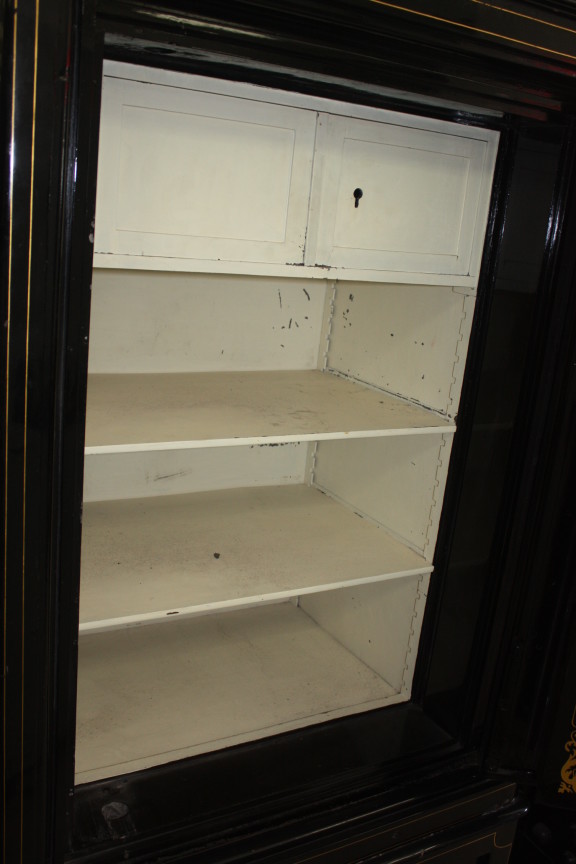
Pictured is an extremely rare Carl Ade antique safe which is for sale in our store.  This may be the only one in the U.S. as I have never seen or heard of another one.  You can find posters and prints of old Carl Ade advertisements, but not actual safes.  A German member of the Safe and Vault Technician’s Association has seen several in Europe.  He said it was built in Stuttgart Germany between 1888 and 1892.  This particular safe was brought to Michigan in the 1970’s by a German manufacturer when they built a factory here.

Carl Odde Safe 008Carl Odde Safe 002Carl Odde Safe 001Carl Odde Safe 006


The safe is 36” tall by 28” wide and is built into a beautiful wooden cabinet which is 67” tall.  It Carl Odde Safe 004features true German quality including the most air-tight door I have ever seen.  The key is a rectangular brass tube ½” x 3/16” x 2 ¼”, with openings on the end and one side to expose precision tumblers inside.  Security is enhanced by unique hook-type bolts, which I have not seen anywhere else.

Carl Odde Safe 022Carl Odde Safe 013

If anyone has ever seen another Carl Ade safe please call to let me know.  We are always looking to buy high quality antique safes and vault doors.

Gun Safe Boltworks, Part 4: Cam or Gear Drive

The majority of gun safes and vault doors come with cam drives. Turn the handle and the spindle transfers that motion to some kind of cam inside the door. The cam then transfers the motion to some type of linkage that moves the bolt bars in or out. Safes with cam drives are easier for burglars to open than safes with gear drives. Why, then do most gun safe manufacturers use cams? Because they make more money selling cheaper (less secure) safes. Consumers almost never see what’s inside the door of their safe, and store personnel don’t know enough to tell them. Without good information, consumers will sacrifice security for a cheaper price.

Blog, boltworks 008 Blog, boltworks 004

Besides offering better security, gear drives make for smoother operation when opening and closing the safe. On most gun safes, whether operated by cam or gear, the handle turns about one quarter to one third of a turn. I especially like the “cool factor” of a handle that spins completely around several times, like Fort Knox’ 5 to 1 rack & pinion drive mechanism.

The safe on the left with a cam drive is much less secure than the unit on right.  Both are made in American, but notice the difference in quality and craftsmanship .  It is hard to tell from the picture but the cam is assembled with press-on fasteners, and the external re-locker was installed incorrectly at the factory.

When looking to buy a gun safe, learn about all the major features – the locks, the type of insulation they use, how the insulation is mounted, how much steel there is, how the boltworks are made, etc. Buy from a place that knows the differences and is willing to show you.

Gun Safe Boltworks: Part 3

Other factors that determine how strong a gun safe or vault door is against a prying attacks include the length of the bolts, and whether pressure is deflected or distributed to parts besides the bolt bar.

Imagine a safe in which, when it is locked, the bolt bar goes right up to that part of the door which frames in the boltworks, lock, re-lockers etc. — that piece about 3” wide through which the bolts stick out. If the bolt bar fits up tight to that frame, and someone is prying on the door, then all the pressure is put right on the point where the bolt is attached to the bolt bar. That point of attachment and the bolt bar would take all the stress.

Now assume that when the gun safe is locked the bolt bar does not go right up to the frame, but stays, for example, 1” away. If someone pries on that door the frame will absorb most of the stress, at the point where the bolts come through the holes. Having a second point of contact makes a huge difference in strength. But some manufacturers use only 12 gauge steel there. Also, the size of the whole that the bolts go through can make a difference. If that hole is much bigger than the bolt itself, then the bolt has more room to move and more of the stress will be passed on to the bolt bar. It is best when the hole is just big enough for the bolt to go through, so any pressure immediately puts the bolt in contact with the frame. Naturally, thicker steel in the frame makes the whole unit stronger

BOLT BARS 017Boltworks 005

The pictures show several methods of adding strength against pry attacks. On the left, for each bolt there is a welded guide piece to keep the bolts aligned. It also acts like a spacer that keeps the bolts back from the frame about ½”, and it makes a third point of contact that absorbs pressure from prying. The bolt bar itself needs help in this safe because it is weak. Note how much of the bolt bar is cut away to reduce material cost, and the steel is only 12 gauge to begin with.

On the right is a brand of safe we sell. Notice that the frame is ½” thick! Bolts are welded to the bar, not attached with a fastener. The bar is 2” X 1/4” and is arranged in a way that yields maximum strength. Incidentally, these safe bolts are stainless steel, not plain steel.

People come to our store from all over the state because they know they will really learn about safes here.  A store or safe dealer should be willing to remove the inner door panel before you buy a gun safe, because you can learn a lot by looking inside. Don’t buy until you see what’s inside.