Gun Safes With Palusol Seals: Part 2

“Palusol”, which is a trademark of Odice, LLC, is the brand of intumescent seal used on most gun safes. When exposed to heat from a fire the product’s thermoplastic covering melts. The underlying material then expands as a foam which makes a barrier to prevent heat and smoke from entering the safe. Palusol is a great product, but there are limitations.

PALUSOL SEALS 002

Shown left to right are three types of Palusol: “PL”; “PM”, what most safe manufacturers use; and “EFV”, which has two small fins on it.

A miner issue is that sometimes the safe manufacturer’s employees do not handle the product carefully. Dirty hands, oil or drywall dust sometime keep Palusol’s adhesive tape from sticking to the safe. The Palusol then peels off and the consumer needs to glue it back into place.

More importantly, doors on some gun safes fit so poorly that the gap between the door and the frame is too big for Palusol to fill when it expands. In this case, heat and smoke will be allowed to enter the safe even after the seal expands.

Odice’s sales material states that for best protection, Palusol PM should be installed flush in a routed groove to direct the expansion of the material properly. None of the safe manufacturers install Palusol this way.

Odice says that Palusol should not be exposed to temperatures greater than 104 degrees for extended lengths of time. It seems, then, that Palusol might lose its effectiveness when the gun safe is in a garage in a part of the country where the temps get that hot.

Here is the biggest problem: Odice states that Palusol is activated at temps between 212 and 302 degrees F. That means that smoke and heat perhaps as high as 300 degrees can pour into most gun safes until the seal’s thermoplastic melts and the inner material expands. In many house fires one part of the house can burn while other areas do not. But the black sooty smoke infiltrates the entire house, and the safe. We have seen a number of gun safes which were not damaged by heat, but whose contents were destroyed by smoke and low level heat, because the seals did not get hot enough to expand.
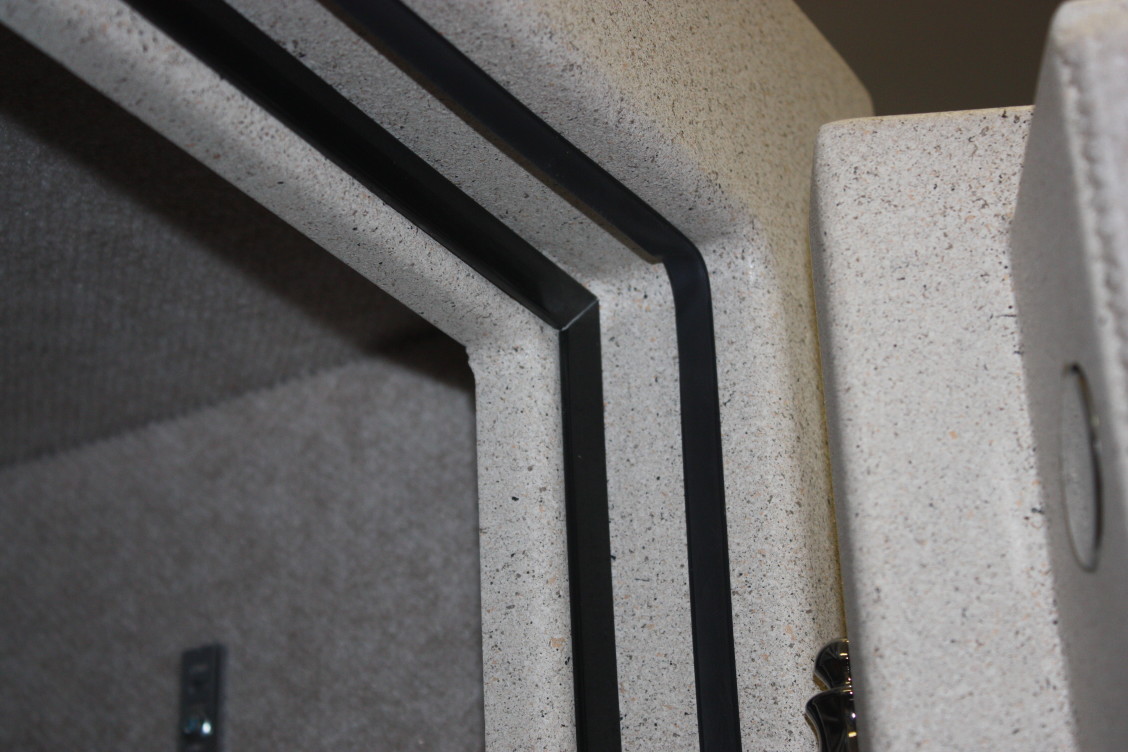
Gun Safe Seals 001

So then how do you get real fire protection? Buy a gun safe with a door that fits well, and which has two seals. A cold seal or smoke seal is critical because it works all the time – before the expanding seal actually expands. Pictured above is the frame of a Fort Knox Defender. The black stripe on the left is Palusol PM, but to the right is a fire resistant fin-type seal which makes the safe airtight all the time. Infiltration of smoke, and air from 212 F to 302 F, will be greatly reduced.  On American Security safes there is a foam compression-type seal which accomplishes the same thing.  But most gun safes, even expensive ones, do not have the important second seal.

Seals on Gun Safes: What Exactly is Palusol?

Most gun safe manufacturers use Palusol brand intumescent fire seals, commonly called the “expanding heat seal”. Palusol is a copyrighted trademark of Odice, LLC. There are several variations of the product with slightly different characteristics, and several thicknesses are available. I believe most gun safe and vault door manufacturers use the “PM” product.

According to Odice’s sales materials, Palusol PM is hydrated sodium silicate material coated on both sides with epoxy resin, the core is reinforced with glass fiber. It is encapsulated in a rigid thermoplastic profile. Self-adhesive tape on the back allows quick installation. The appearance of this seal is a shiny clean straight line on the edge of the door or on the frame of the gun safe.  At least one manufacturer uses a variation that comes in rolls rather than rigid strips; it saves time in production, but looks cheap.  Pictured is the edge of an American Security BF safe door showing the rigid version Palusol seal right behind the 1/2″ plate steel door front.  Tape over the corner keeps the strips from coming loose.  In addition, taping over the cut ends of the Palusol prevents air and moisture infiltration which can cause deterioration of the product.

DOOR EDGE STEEL 005

When exposed to fire Palusol’s thermoplastic covering melts. That allows the sodium silicate material to expand, filling in gaps between the door and frame of the safe. It becomes a rigid non-combustible foam with a high level of thermal insulation. According to Odice this expansion is equal to, or greater than, five times the material’s original thickness (not eight times thicker as claimed by a number of gun safe manufacturers). This makes for a barrier to the passage of fire, hot gasses, smoke, etc.  Palusol has been tested by independent labs.  Under normal conditions it has been shown to be effective for at least 25 years.

The next post will talk about the limitations of Palusol seals in most gun safes.

How To Fix Cheap Shelves in a Gun Safe

Cheap gun safes, especially Chinese made safes that are sold in big box stores, almost always have weak shelves.  The shelves are made of inferior particle board which is thinner than it should be, so the selves hold very little weight before they sag or break.  I have seen brand new Chinese made safes that sag just from their own weight.  Naturally, the wider the safe is this worse the problem becomes.

SHELF SUPPORTS 002 SHELF SUPPORTS 006

In my opinion it should not be necessary to fix a problem like that with a new safe, or avoid using the shelf for fear of it breaking, but there is an easy fix.  The clips that the shelves rest on are usually 1/2” or 5/8” wide.  At your local home improvement store buy some metal u-channel or square tubing that is big enough to go over the clips.  Cut the material to the correct length and slip it over the clips on both sides of the safe.  Your shelves will then lay flat and hold much more weight than before.

Fort Knox being a quality oriented company uses better, thicker shelving material.  And on 51” or 61” wide safes they install tubing for support at the factory.  As I always tell people, don’t save a few dollars by buying Chines made junk – buy an American made gun safe from one of the few trustworthy manufacturers.

New Home Design, Plan for the Safe

One feature which is frequently overlooked in the design of a new home is where to put a safe or vault room.  Too often the homeowner calls us after the house is built, and then it is more difficult to find a good place for the right safe.  In the home pictured, a cubby hole was built so that the owner’s gun safe fits right where he wanted it, and it does not stick out into the room.

Blog, Safe Planning (2)

Most owners of medium to high-end homes have need of a safe.  Everyone has important documents that should be kept private and protected from fire – wills, trust papers, investments, mortgage papers, etc.  Many homeowners also keep substantial amounts of cash, jewelry, metals, coins, stamps, sports memorabilia, and so on.

Each application has different requirements.  For example, if a woman regularly wears expensive jewelry she should have a jewelry safe located where she dresses, so she can access it easily.  If the safe is in the basement she will still leave her jewelry sitting out.  Cleaning people may then be tempted, or someone who breaks into the home for a quick “grab and run” may find it.  If her safe is small it should not sit on the floor.  Getting down on hands and knees to look for a ring or necklace is inconvenient.  And remember that as she gets older her knees and back will give her more trouble.  A small safe mounted securely at about eye level works out much better, and tall skinny unit works even better.  Proper planning when the home is designed makes these options possible. Likewise, putting a vault door or a really heavy safe in a home is much easier if planning is done in advance.

If you are the builder or architect, make sure to ask the homeowner about safes early in the process.  If you are the homeowner, don’t be tempted to put this issue off until later.

The Best Batteries for Electronic Safe Locks

We get this phone call every day:  “My safe has an electronic lock and I have changed the batteries but it still won’t open.”  Usually the problem is that they put in cheap batteries.  Yes, there is a difference.

J BAWM & VULCAN 007

Whether the lock is on a fire safe, commercial safe, gun safe or vault door, the ONLY batteries that will consistently work electronic safe locks are Duracell and Energizer alkaline.  Store brand batteries and even the other famous brands are inferior.  The voltage will be the same on most of them, but the amps will be higher on Duracell and Energizer. Electronic safe locks need high amps to work properly. Use batteries that are fresh from the store, not the ones that have been sitting in that kitchen drawer for six years.  Don’t use rechargeable batteries, either.

One more word of advice:  Be really careful when changing batteries on electronic safe locks so you don’t break the contacts or connecting wires.  That will require the help (and the fee) of a safe technician.