Interior Options on Gun Safes

If you have shopped for a gun safe you have run into the “one size fits all” interior configurations.  Everyone is supposed to want the same set-up – a vertical divider in the center and 10 to 15 gun spaces on each side.  But that doesn’t work well for everyone.

I sold a gun safe to a woman this week who has just two rifles, and plans on one more.  She has lots of other stuff that needs to be secured, however.  So why should she waste half of the interior space for just two rifles?  A Fort Knox unit in the 60 X 31 X 27 size with a four-gun interior works perfectly for her.  She has four full width shelves for jewelry, pistols and documents with just a small area dedicated to long guns.
img_2519

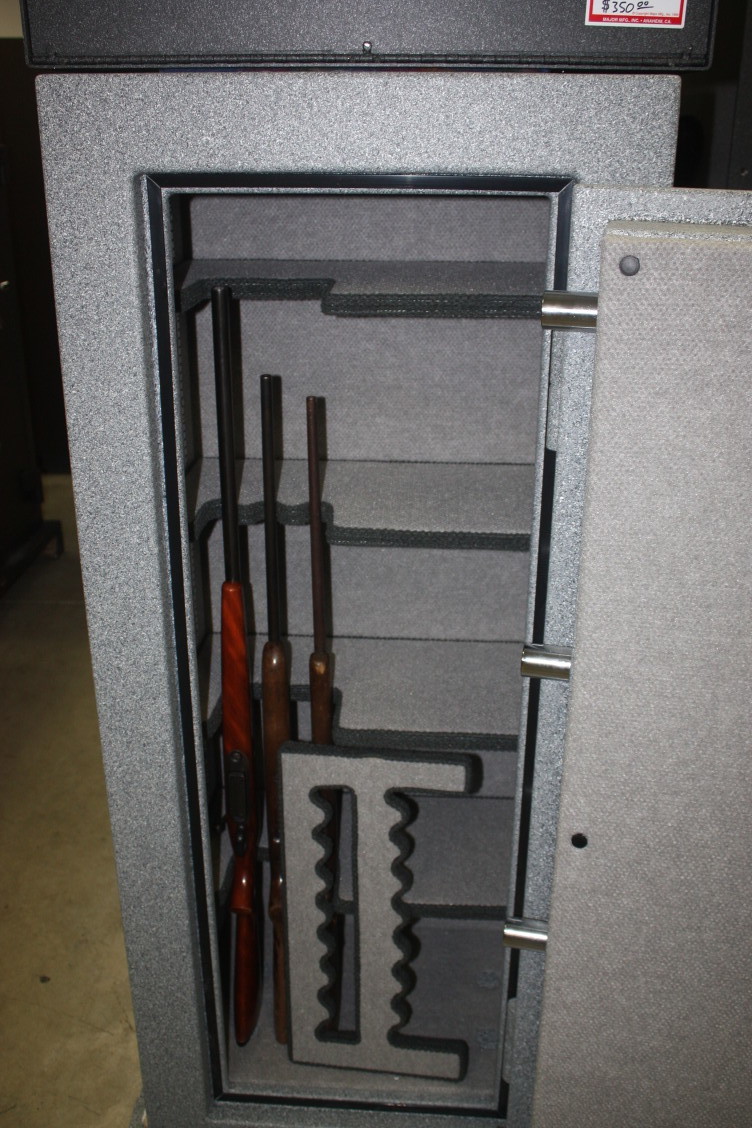
Fort Knox has many different interior configurations so the owner can use the space efficiently.  A 60 X 31 X 27, for instance, can be set up to handle 4, 8, 13, 18, 26, 31, 36 or 40 long guns.  If your needs change in a few years you can order different shelving.  The photo shows a small unit, 60 X 26, with a 3 gun interior.  Lots of usable shelf space.  Other alternatives include the “all gun” rack shown at the bottom, which has 18 spaces.

Fort Knox dealers will have lots of gun safe options in stock, and lead times for special orders are usually only about 6 to 8 weeks.  Fort Knox specializes in allowing you to get exactly what you want by offering many sizes, security levels, colors, lock arrangements, etc.  Don’t “make do” with a gun safe that doesn’t fit your needs, just because it’s the only choice offered.  Go to a Fort Knox dealer and spec out a unit that is exactly what you want, including the right interior.

Gun Safes Make Great Christmas Gift, But . . .

Gun safes, as well as regular fire/burglary safes, make terrific Christmas gifts provided that the unit selected is appropriate for the recipient’s needs.  That can be a problem, however, because the well-intended purchaser often does not appreciate the differences in quality, and they may not know about everything the user will store in the safe.  The buyer is usually a spouse or “significant other” who is buying an special, useful gift.  Understandably, they are focused on price because even a cheap gun safe is a big purchase.

Big box stores take full advantage of this situation with Black Friday sales and Christmas sales.  They sell thousands of cheap Chinese units which, to the person who doesn’t do proper research, appear to be suitable.  The result can be that the gun owner ends up with a safe he would not buy for himself.  It might not offer the protection he knows he should have.  While truly appreciating the thought behind a major gift, he may have unspoken doubts about it, and it’s a difficult gift to return.  We have all been there with one gift or another.

So here are my suggestions:

  • Don’t buy a gun safe as a surprise. Talk about it in advance.  Get his/her input about brand, size, and value of what it will be used for.  Select a manufacturer like Fort Knox that offers a range of security levels.
  • Be wary of Black Friday and Christmas sales.
  • Don’t buy only, or primarily, based on price.
  • Don’t buy a Chinese product.
  • Both parties should learn the basics about gun safes, the differences in brands and models. A good place to start is by reading my earlier posts about gun safes, safe locks, etc.
  • Buy from a legitimate safe store, not a gun store or big box. Your research should include talking directly with safe experts who actually service different brands.
  • If cost of a good unit is too high, then agree that this gift will be for Christmas and the next birthday, or this Christmas and next, or have them pitch in on the cost, or get their family to contribute.

Honestly, a quality gun safe or fire/burglary safe is a gift they will actually use and remember for years, even if they need to help with the cost.  But the memory will be less positive if it is one of those gifts that he/she would secretly prefer to return for something better.

Gun Safe Ruined by Locksmith

The previous post was about a gun safe that was destroyed by a locksmith who had no idea what he was doing.  Last week we had an even worse instance of this kind of work by a different locksmith with similar lack of knowledge.

img_2442

The “victim” came to our shop needing to buy a replacement gun safe.  His had been ruined when he called a locksmith to open it.  The locksmith told him the only way to get it open was to cut a hole in the door. It had been a good safe with heavy steel and good boltworks.  As you can see the safe was butchered.  The locksmith left a pile of metal shavings on the floor and filled the customer’s entire house with drywall dust.  The customer was charged $1200! And now he needed to buy a new gun safe!!

The real tragedy is that the problem was a loose spline key in the lock (see July 25 post) which we would have opened without even drilling a hole!

The man is now the proud owner of a Fort Knox gun safe, but he is very angry at the guy who cost him lots of money.

Again – if you have a safe problem, call a trained safe tech, not just a locksmith.

Why a Safe Lock Quits Working Gradually

Here is a call we often get that drives me crazy:  “My safe quit working today and I can’t get it open.  The lock started acting up about four months ago and kept getting worse, but now it won’t open at all.”  The safe now needs to be drilled open and they complain about a bill of $300 to $400.

spline keys 012spline keys 002

The most common reason a combination lock goes bad gradually, and then fails completely, is a loose “spline key”.  When you turn the dial on a good combination lock a spindle transfers that movement to the lock body which is mounted on the inside of the door.  Three or four wheels and some other parts are held in place on the spindle by a tiny L-shaped spline key, pictured on left.  The other photo shows the inside of a Group 2 lock.  At the center of the “drive wheel” is the spindle.  It is grooved to hold the spline key (here pointing to 10:00) that in turn unites the wheels to the spindle.

When the spline key gets loose the wheels move, so they are no longer in sync with the dial.  The lock will not open consistently even when dialed accurately.  Keep trying to use the lock and the spline key will loosen up more, until it hits the inside of the lock cover or it falls out completely.  In either case you are locked out of your safe.

When your safe acts up, don’t put it off.  Avoid paying to drill it open by calling a competent safe technician immediately when you have problems.

Gun Safe or Burglary Safe: The Affect on Insurance

Customers always ask about insurance coverage when they have a gun safe or burglary safe.  There are lots of assumptions and questions, so I called several agents that handle home insurance, and here is what I was told.

One said that usually, if you have a burglary safe you can get a small savings on your annual insurance cost, probably around $10; the other disagreed.  Ask your agent.  The next paragraphs talk about coins in particular, but collections of guns, jewelry, watches, etc. will be similar.

They both said that, if you don’t have your coins scheduled or itemized on a rider, your policy will usually cover up to about $500, whether they are in a safe or not.  But they will only be replaced at face value, so numismatic value will not apply.  A penny that is worth $50 to a collector will still be reimbursed for $.01.  Value of the silver or gold content most likely will not count either.

If you have your collection appraised and covered on a rider, they will be covered up to the appraised value.  (My coin guy charges $50/hour to do written appraisals.)  When that value is based mostly on the gold or silver weight, however, be careful.  If the appraisal is done when gold is $1300 per ounce, and you are robbed when gold is worth $1600 per ounce, you will be reimbursed at the original $1300 value.  Cost of the insurance rider will probably run about $38/year for every $10,000 in value provided the collection is in a safe.  Cost will go up about $4 to $5 per $10,000 in value if there is no safe.

All kinds of variables affect insurance, including where you live, which insurance company you use, your loss history, etc.  For an extremely high value collection there may be better coverage with a TL-rated safe.  There might be specialized policies for high value collections, like there are for classic car collections.  Some items are irreplaceable because of sentimental value, like Great Grandpa’s old rifle or Grandma’s wedding ring.  To the insurance company they are probably only worth generic value.  I am certainly no expert.  Don’t make assumptions – ask your agent lots of questions.

You should always have insurance coverage on your valuables.   But the best protection against theft in the first place is to have a really good gun safe or burglary safe and good home security.  Don’t take a chance that you may not be properly reimbursed after a loss.  Prevent the loss!