Coolest Gun Safe on the Market, From Fort Knox

Fort Knox Safes is famous for allowing the consumer to customize the gun safe he wants.  This year Fort Knox introduced two more options that offer cool new looks, more ways to get your gun safe your way.

Old, very retro industrial design is fashionable.  This is especially true where old factories and warehouses are being converted into desirable apartments and condos.  Fort Knox’ new “Distressed Industrial” finish fits right in.  Each gun safe is different with the addition of big rivets and random distress marks to the paint.  Besides rehabilitated industrial buildings these units look good in your work shop area or man cave.

DISTRESSED 4 002DISTREESED FINISH 006

The other terrific new option is Fort Knox’ crane hinge.  This is also a throw-back to the old days.  A hundred years ago very heavy safes and vault doors were frequently built with crane hinges to help the doors move more freely.  This system makes safe doors that are actually double-hinged, so they move in a more three dimensional manner.  Crane hinges are available on all Fort Knox gun safes (except Mavericks) and in all finishes.  D6031 and D7240 shown.

If you want to really impress your friends — and get serious security at the same time — get a Fort Knox gun safe or vault door with the new Distressed Industrial finish and crane hinges.  Awesome!
Customize Your Fort Knox Gun Safe

Most brands of gun safes are mass produced with little or no flexibility in colors or options. Fort Knox gun safes (excluding the Maverick series) can be customized to create your own one-of-kind safe that truly reflects your needs and taste. Here are some of the options Fort Knox gives you:

  • Nine sizes of gun safes
  • Internal or external hinges, on the left or right
  • Three textured paint colors and thirteen high gloss paint colors
  • Two tone paint schemes or custom blended colors
  • Eight interior configurations, with five fabric selections
  • Door organizers or Velcro compatible inside door panels
  • Two interior light packages
  • Multiple different graphics packages
  • Up-graded fire protection
  • Add extra steel to the safe body and/or the door – you decide how much
  • Add stainless steel or Armaknox Ballistic AR500 steel
  • Add corner bolts to units that don’t normally have them
  • Pull handles to make opening a heavy safe door easier
  • Locks: Group 2, Group 1, electronic or redundant
  • All kinds of accessories and extras: Mirror inside back wall; jewelry drawers; pistol pockets & storage bags; carpeted pedestals; humidity control, etc.

FORT KNOX BLOG 002FORT KNOX BLOG 006

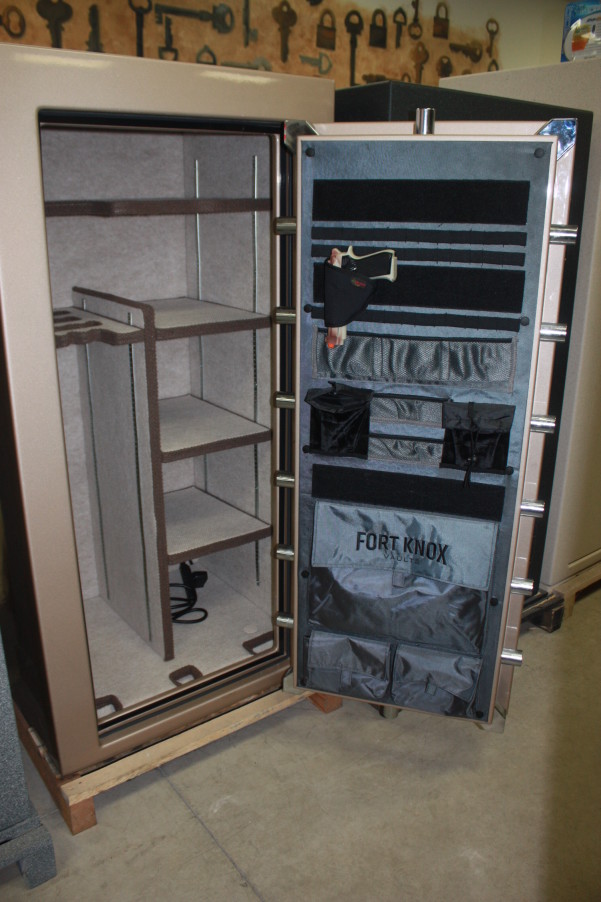
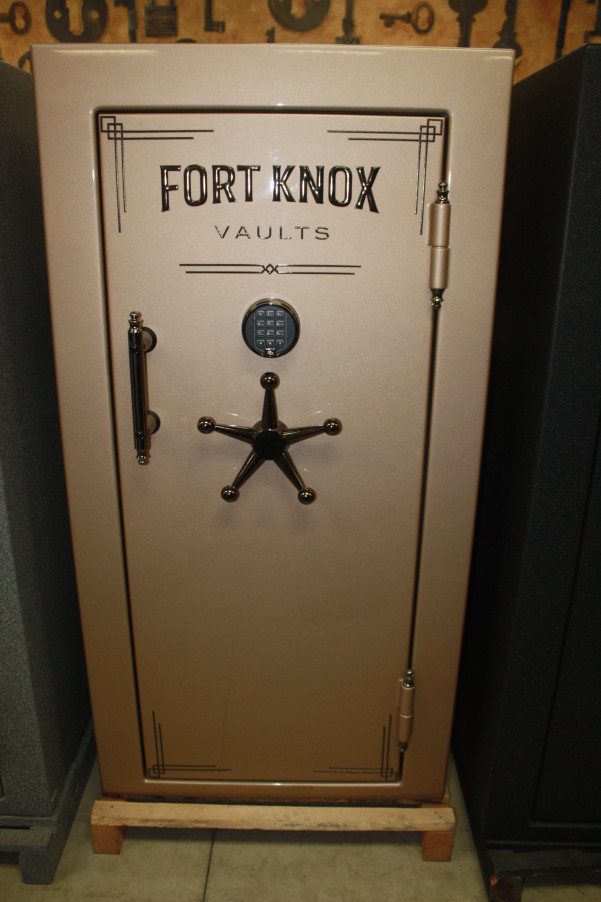
The safe shown is a Fort Knox Guardian 6031 in Champaign color, with black chrome hardware & trim, and beige interior. Options include external hinges, pull handle, raised double diamond graphics, electronic lock, internal lights and an inner steel lining of 10 gauge steel. Standard features include the 5 spoke handle, corner bolts, door organizer, internal electric plug, etc.

Everyone’s needs and preferences are different: You store gold, your friend stores silver; you have 47 valuable rare rifles, your friend has 5 low end shotguns; you like black, he likes green; your safe will be a showpiece where everyone sees it, his will be hidden in the furnace room; you keep lots of cash at home, he doesn’t. You need more protection than your friend and you want to project your personality. Don’t buy the same (inferior) gun safe that everyone else buys at the local box store. Work with your Fort Knox dealer to design something special – something with real protection and style.

Vault Doors: Importance of Seals

In my last blog about vault doors, I mentioned the ridiculous fire ratings that some manufacturers claim to have, based solely on how much drywall insulation they use when their doors have never been tested.  Now consider the seals used between the doors and frames.

To see the importance of seals on vault doors read my last few postings about gun safes.  Look at the test data that shows how poorly most of them (all of which use a single heat-expanding seal) perform – how heat and smoke can infiltrate the safe before and after the expanding seal actually expands.  The insulation in gun safes creates a positive steam pressure, because of the small confined interior space, to help push out the really hot air and smoke.  This phenomenon will not occur with a walk-in vault because the interior space is so large.  So an effective cold seal, in addition to an expanding seal, are even more important on a vault door than on a safe.  And yet most vault door manufacturers use a single, expanding type seal.

Expanding seal on door edge, cold seal in door jamb

American Security vault doors are built and sealed the same way as their BF safes, the safes that did so well in the fire test.  It is logical that their vault doors will work the same way.  I suspect that Fort Knox vault doors would perform in a similar way too because they have both cold and heat expanding seals.

When you look to buy a vault door, do not trust any claim the manufacturer makes about a “fire rating”, unless it has been tested and certified by U.L.  The best you can do is to get one in which the door fits tight and there are two kinds of seals.

Gun Safes and Fire: Seals, part 2

Below is a smaller portion of the test curve which was shown in the previous blog.  Note how with the three inferior safes the inside temp shoots almost straight up at the beginning of the test.  Then at about four minutes the curve turns back down slightly before shooting up again.  This momentary reversal happens when the expanding heat seals get hot enough to expand.  It does help, but it is clearly inadequate.

Fire Test Chart

If there is a large gap between the door and the door frame, or the door does not close snugly, then heat and smoke will just pour in. In theory when the insulation gets hot enough to release moisture it provides a degree of cooling. And the resulting water vapor should create a positive pressure to keep really hot air from coming into the safe.  But these affects are not enough to overcome poorly designed doors which do not seal.

Gun Safe Seals 006

So why did the American Security safe perform so well?  First, these safes have plate steel doors that have tight tolerances so the doors fit properly.  Second, these units have two types of seals.  They have an expanding seal like other safes (top edge of door in photo above). But they also have a cold seal (in door frame) that keep out heat and smoke even before the expanding seal gets hot enough to work.  Makes perfect sense, doesn’t it?  None of the test safes were by Fort Knox, but most Fort Knox gun safes also use double seals.  The inner seal (see photo below) expands, while the outer seal is a fin-type which is very air tight all the time.  Graffunder gun safes use double seals, too — see earlier post.

Gun Safe Seals 001

Why don’t other safe manufacturers use double seals?  Some choose to sacrifice real protection in favor of lower costs.  When buying a gun safe, make sure the door fits properly and make sure it has both hot and cold seals

Gun Safes and Fire: Seals Are Important

Just as important (maybe more important) as the insulation used in gun safes, is the type and number of seals used around the door.  Some manufacturers claim to have terrific fire ratings – numbers made up based on the amount of drywall they use – but then poor fitting doors and inadequate seals allow heat and smoke to rush to in during a fire.

img064

This portion of a fire test graph illustrates my point perfectly.  It comes from Intertek ETL Laboratories, an independent testing lab.  Results were released this January for fire tests done on four gun safes in December 2013.  Temperature is shown on the vertical axis, time on the horizontal.  During the test, the furnace temperature was raised to 1200F in 8 minutes, then held steady until the end.  Temperature sensors were located inside each unit 7” from the top.  A safe is considered to fail when it’s inside temp hits 350F.

Looking at the test curves from right to left, the curve furthest to the right is for an American Security BF gun safe.  This safe lasted for 126 minutes before the internal temp reached 350F – over two hours!  I cannot name the other manufacturers here, but they are very well known.  The next curve to the left is a top-of-the-line unit with a 2.5 hour “fire rating”.  Few companies claim to have a fire rating that high, but when this safe was tested by ETL it failed in only 69 minutes – less than half what the manufacturer claims.  The next safe has a 60-minute rating but it lasted only 47.5 minutes.  The final unit is said to have a two-hour rating but, incredibly, it failed in just 9 minutes!!  That’s some kind of great fire protection, isn’t it?

Next time:  Explanation for the successful test and the failures.