Putting a Safe or Gun Safe in a Garage, Part 2

If you need to put your safe or gun safe in the garage here are the steps you should take:

  • Invest in a heavier, higher quality vault, preferably TL-rated like American Security’s RF series gun safe.
  • Conceal the safe the best you can. Build a cabinet around it or drape a blanket or something over it.  American Security sells what they call a “Safe Cloak” for gun safes which is a fabric cover that makes your safe look like a cheap storage cabinet.  It attaches to you gun safe with a magnet across the top and hangs down to ground level.  If possible, put the safe in a back room or around a corner.
  • Don’t allow service people or delivery personnel to go through your garage.
  • Keep your garage door locked at all times to keep people out.
  • Increase the perceived risk to a burglar — put up a sign stating that the house and garage are monitored. It helps to install a very conspicuous camera, even if it is fake.
  • Anchor your safe to the concrete floor using high grade anchor bolts.   Most fire safes are light enough to be picked up.  If you don’t have the right tools or skills, hire someone who does.
  • Don’t keep pry tools, sledge hammers, torches, etc. in the same area – keep them locked up in the house.

To avoid problems from cold and fluctuating temperatures in northern states:

  • Use a dehumidifier rod (heat bar) inside the safe to keep temps as stable as possible.
  • There can be a problem in those first warm humid days of spring when the ground is still very cold. The cold floor will keep pulling warmth from the safe causing condensation, making the safe sweat, which encourages rust.  Antique safes are especially prone to rust.  It is best, therefore, to have a small amount of contact with the floor.  Thin squares of wood or plastic at the corners will minimize the problem.  We usually use pieces of the plastic shims used to install windows and doors.  Important Note:  Don’t raise the safe too far off the ground; the bigger the gap there is between the floor and the safe, the easier it is for someone to move the unit.  A big gap makes anchoring less effective too.
  • Battery life in electronic locks will be shorter in cold situations. I would guess that electronic locks themselves would have shorter lives, but that is just speculation.  Dial locks are less affected by cold.

Keeping your gun safe in the garage is less than ideal.  Minimize risk by taking proper precautions.
Putting a Safe or Gun Safe in the Garage

Customers regularly ask if putting their safe in a garage or pole building, as opposed to inside the house, creates any potential problems.

A safe or gun safe in the garage is typically not as secure, for the following reasons:

  • Depending on placement, it might be that every time you open the garage door the safe is visible to whoever is driving or walking past the home.
  • It is likely to be seen by delivery or service people like UPS, FedEx, the gardener, maintenance personnel, etc., people who have legitimate reasons to go into the garage.
  • A safe may be seen by neighborhood kids who enter the garage looking to steal bicycles, beer, etc.
  • Everyone has heard stories of the ATM or safe that was stolen when burglars put a chain around it and dragged it off. In a garage or pole building, burglars could open the overhead door and back a truck right in so they could easily do the chain trick.
  • Many older safes are on wheels which allows someone to just roll them outside.
  • With a safe or gun safe in the garage, you could even be in the house watching TV or sleeping while someone is working to open it with quiet tools like torches.
  • Many garages are loaded with tools that burglars would find useful in opening your safe.

Aside from security issues, temperature variations in northern states can cause problems for safes in garages.  Rust and lock problems are not uncommon.

The next post will cover how to protect your safe or gun safe from these issues.

A Good Alternative to a Gun Safe for Storing Guns

Instead of buying a cheap gun safe because your budget is limited, consider spending a similar amount on a good used commercial safe and make your own “gun safe”.  You may be way better off both fire-wise and security-wise.

IMG_2569IMG_2571

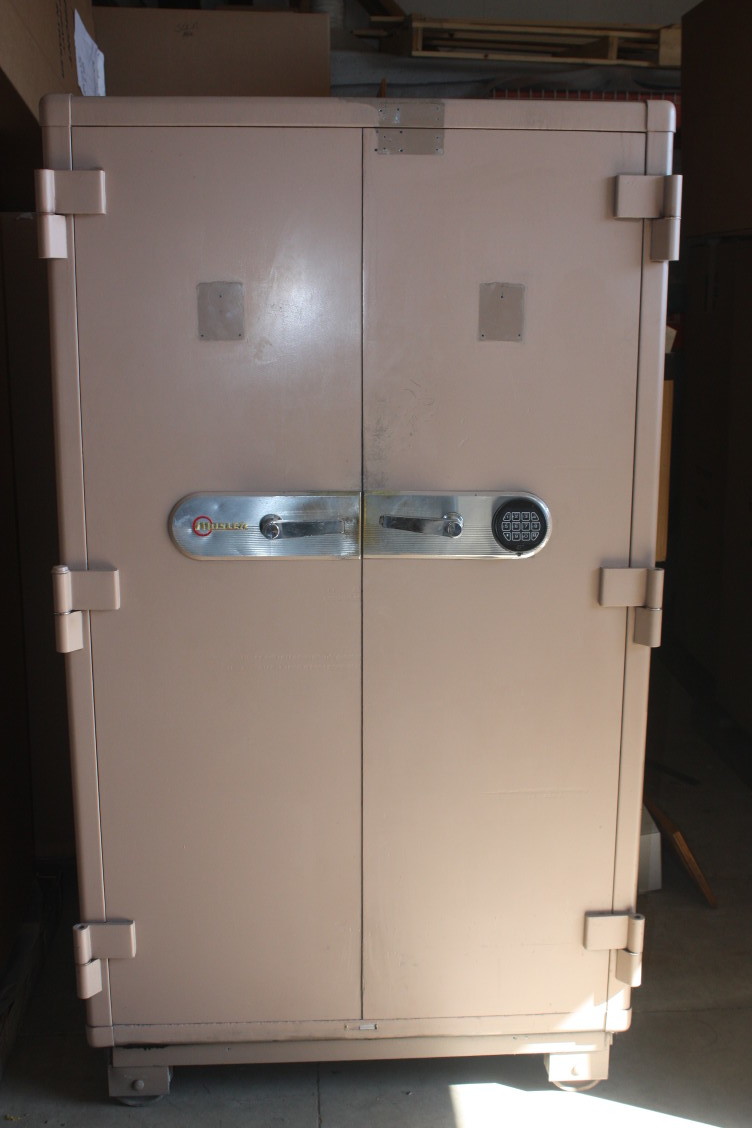
For example, pictured is a commercial safe we took in last week.  It was used in a high security situation – you can see where several types of alarms were mounted to the front.  It also has a legitimate 4-hour U.L. certified fire rating.  There are several gun safes with ratings as high as 2.5 hours, but those ratings are bogus and the safes would never pass U.L. tests for that long.

The Mosler safe shown is 76”H X 42.5”W X 30”D outside and 60 X 33 X20 inside.  That is 23 cubic feet of inside capacity.  We will sell it for $1500.  So if you invested a few hours into making a gun rack, and maybe painting it, you would end up with an outstanding unit for the price of a poor quality gun safe.  Check with your nearest safe dealer for similar opportunities.  If you live in Michigan come see us.

Gun Safe Destroyed in Fire

It has been a long time since I wrote about the inferior insulation used on most gun safes, and the inferior way it is installed.  The photo below prompted me to comment on the subject again.  The picture shows a gun safe (made by the best-known manufacturer) which went through a fire earlier this year.  As you can see this gun safe failed completely.  The “Type X” drywall is in pieces in the safe, along with the remainders of expensive shotguns.

2017021795

Brief refresher:  Type X drywall shrinks and breaks into pieces when heat from a fire cooks out the moisture.  Glue used to install the drywall gets soft and lets go, so the drywall caves in.  That glue probably burns, too.

Do not buy a gun safe that uses Type X drywall installed with glue!  There aren’t many good choices because almost every gun safe manufacturer uses this type of construction.  Try Fort Knox, Graffunder and American Security’s BF line.

Interior Options on Gun Safes

If you have shopped for a gun safe you have run into the “one size fits all” interior configurations.  Everyone is supposed to want the same set-up – a vertical divider in the center and 10 to 15 gun spaces on each side.  But that doesn’t work well for everyone.

I sold a gun safe to a woman this week who has just two rifles, and plans on one more.  She has lots of other stuff that needs to be secured, however.  So why should she waste half of the interior space for just two rifles?  A Fort Knox unit in the 60 X 31 X 27 size with a four-gun interior works perfectly for her.  She has four full width shelves for jewelry, pistols and documents with just a small area dedicated to long guns.

img_2519

Fort Knox has many different interior configurations so the owner can use the space efficiently.  A 60 X 31 X 27, for instance, can be set up to handle 4, 8, 13, 18, 26, 31, 36 or 40 long guns.  If your needs change in a few years you can order different shelving.  The photo shows a small unit, 60 X 26, with a 3 gun interior.  Lots of usable shelf space.  Other alternatives include the “all gun” rack shown at the bottom, which has 18 spaces.

Fort Knox dealers will have lots of gun safe options in stock, and lead times for special orders are usually only about 6 to 8 weeks.  Fort Knox specializes in allowing you to get exactly what you want by offering many sizes, security levels, colors, lock arrangements, etc.  Don’t “make do” with a gun safe that doesn’t fit your needs, just because it’s the only choice offered.  Go to a Fort Knox dealer and spec out a unit that is exactly what you want, including the right interior.