Vault Doors: Importance of Seals

In my last blog about vault doors, I mentioned the ridiculous fire ratings that some manufacturers claim to have, based solely on how much drywall insulation they use when their doors have never been tested.  Now consider the seals used between the doors and frames.

To see the importance of seals on vault doors read my last few postings about gun safes.  Look at the test data that shows how poorly most of them (all of which use a single heat-expanding seal) perform – how heat and smoke can infiltrate the safe before and after the expanding seal actually expands.  The insulation in gun safes creates a positive steam pressure, because of the small confined interior space, to help push out the really hot air and smoke.  This phenomenon will not occur with a walk-in vault because the interior space is so large.  So an effective cold seal, in addition to an expanding seal, are even more important on a vault door than on a safe.  And yet most vault door manufacturers use a single, expanding type seal.

Expanding seal on door edge, cold seal in door jamb

American Security vault doors are built and sealed the same way as their BF safes, the safes that did so well in the fire test.  It is logical that their vault doors will work the same way.  I suspect that Fort Knox vault doors would perform in a similar way too because they have both cold and heat expanding seals.

When you look to buy a vault door, do not trust any claim the manufacturer makes about a “fire rating”, unless it has been tested and certified by U.L.  The best you can do is to get one in which the door fits tight and there are two kinds of seals.

Gun Safes and Fire: Seals, part 2

Below is a smaller portion of the test curve which was shown in the previous blog.  Note how with the three inferior safes the inside temp shoots almost straight up at the beginning of the test.  Then at about four minutes the curve turns back down slightly before shooting up again.  This momentary reversal happens when the expanding heat seals get hot enough to expand.  It does help, but it is clearly inadequate.

Fire Test Chart

If there is a large gap between the door and the door frame, or the door does not close snugly, then heat and smoke will just pour in. In theory when the insulation gets hot enough to release moisture it provides a degree of cooling. And the resulting water vapor should create a positive pressure to keep really hot air from coming into the safe.  But these affects are not enough to overcome poorly designed doors which do not seal.

Gun Safe Seals 006

So why did the American Security safe perform so well?  First, these safes have plate steel doors that have tight tolerances so the doors fit properly.  Second, these units have two types of seals.  They have an expanding seal like other safes (top edge of door in photo above). But they also have a cold seal (in door frame) that keep out heat and smoke even before the expanding seal gets hot enough to work.  Makes perfect sense, doesn’t it?  None of the test safes were by Fort Knox, but most Fort Knox gun safes also use double seals.  The inner seal (see photo below) expands, while the outer seal is a fin-type which is very air tight all the time.  Graffunder gun safes use double seals, too — see earlier post.

Gun Safe Seals 001

Why don’t other safe manufacturers use double seals?  Some choose to sacrifice real protection in favor of lower costs.  When buying a gun safe, make sure the door fits properly and make sure it has both hot and cold seals

Gun Safes and Fire: Seals Are Important

Just as important (maybe more important) as the insulation used in gun safes, is the type and number of seals used around the door.  Some manufacturers claim to have terrific fire ratings – numbers made up based on the amount of drywall they use – but then poor fitting doors and inadequate seals allow heat and smoke to rush to in during a fire.

img064

This portion of a fire test graph illustrates my point perfectly.  It comes from Intertek ETL Laboratories, an independent testing lab.  Results were released this January for fire tests done on four gun safes in December 2013.  Temperature is shown on the vertical axis, time on the horizontal.  During the test, the furnace temperature was raised to 1200F in 8 minutes, then held steady until the end.  Temperature sensors were located inside each unit 7” from the top.  A safe is considered to fail when it’s inside temp hits 350F.

Looking at the test curves from right to left, the curve furthest to the right is for an American Security BF gun safe.  This safe lasted for 126 minutes before the internal temp reached 350F – over two hours!  I cannot name the other manufacturers here, but they are very well known.  The next curve to the left is a top-of-the-line unit with a 2.5 hour “fire rating”.  Few companies claim to have a fire rating that high, but when this safe was tested by ETL it failed in only 69 minutes – less than half what the manufacturer claims.  The next safe has a 60-minute rating but it lasted only 47.5 minutes.  The final unit is said to have a two-hour rating but, incredibly, it failed in just 9 minutes!!  That’s some kind of great fire protection, isn’t it?

Next time:  Explanation for the successful test and the failures.

Gun Safes: Other Types of Insulation

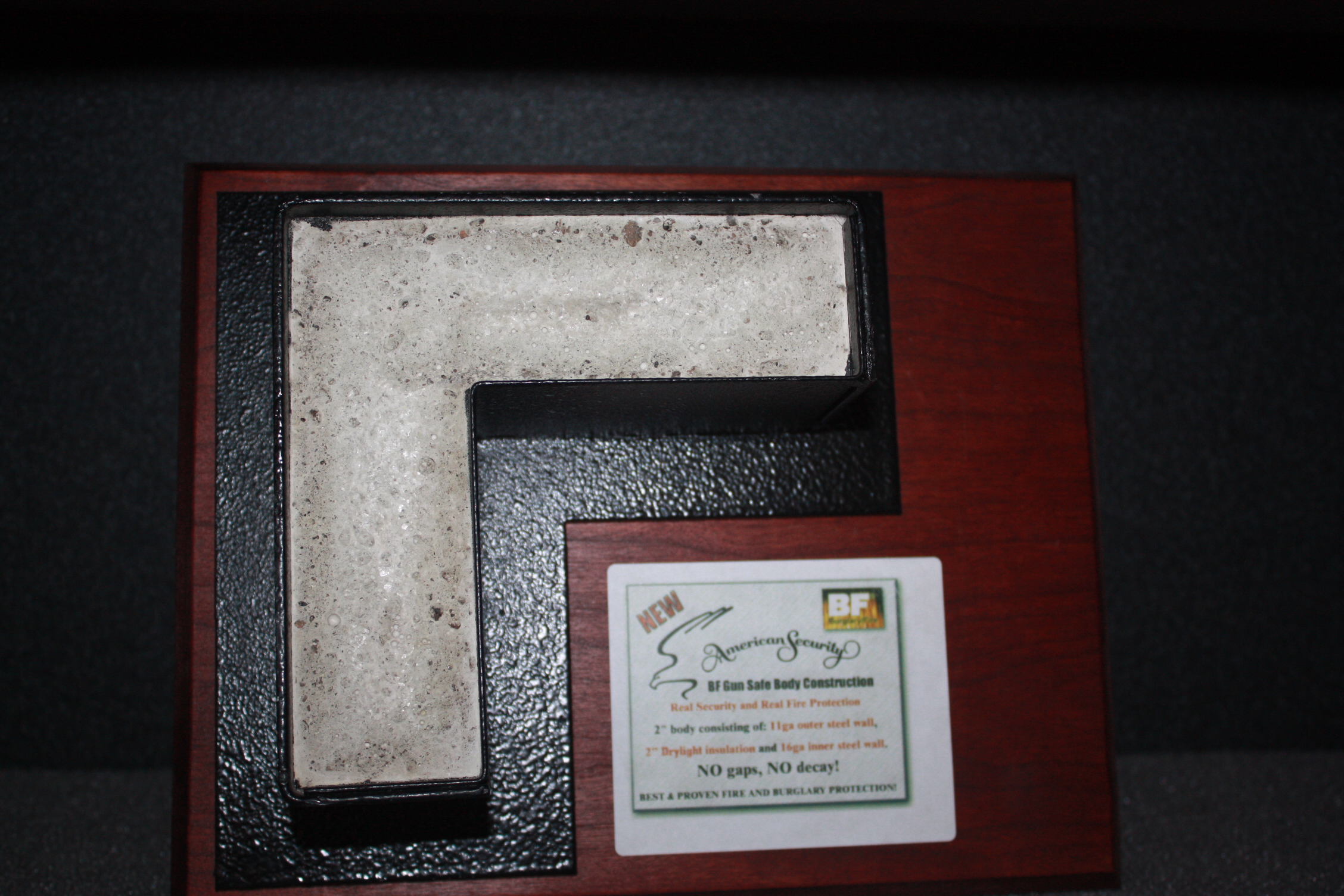
Rather than using dry-wall for insulation (see previous post), Graffunder safes and Amsec BF safes use poured-in concrete based composite materials.  This requires an inner layer of steel so the gun safe body ends up being stronger and more difficult to cut into.  The inner steel also prevents insulation from caving in like Type X drywall.  Making safes with poured-in composite material is a slower and more costly manufacturing process, resulting in a superior product.

Liberty Insulation 006
Amsec BF: Inner and outer steel, poured-in composite insulation

A less common form of fire protection is the use of a thermal blanket made from fiberglass or ceramic fiber. This is supposed to reflect heat away before it gets to the inside of the safe.  I have no idea how well it works, but it does not provide any actual cooling effect like the moisture release from dry-wall or composite materials.  Whatever heat does get inside, however, — mostly through the gap between the door and frame – will certainly be trapped inside.  That will lengthen the time it takes for the safe to cool down after a fire.

Gun Safe Fire ratings: Insulation

Consumers are usually surprised to find that the majority of gun safes use dry-wall for insulation — aka sheetrock, wall board, etc.  Commercial and residential fire safes are not built this way, but dry-wall construction allows gun safe makers to have lower start-up costs and faster production speeds.

Dry-wall contains moisture which gets forced out by the heat of a fire, in the form of water vapor.  That happens at about 300 to 330 degrees, and it actually provides cooling, similar to water evaporating off your skin.  The water vapor then creates a positive steam pressure inside the safe.  This pressure will minimize heat and smoke infiltration if there is a good fit between the door and frame (something missing in many safes).

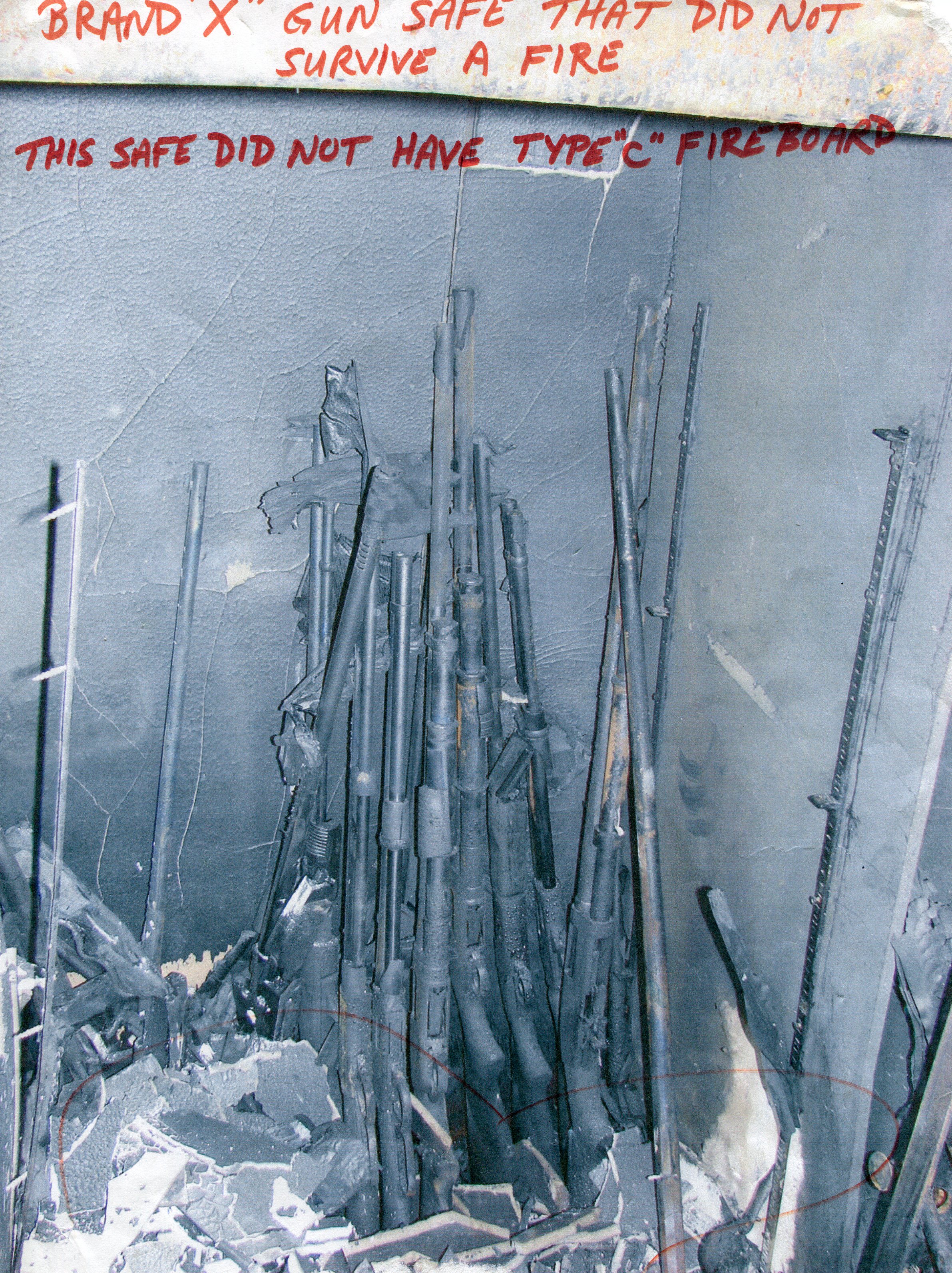
There are several types of dry-wall.  As far as I can tell every gun safe manufacturer that uses dry-wall, except for Fort Knox, use “Type X”.  As “type X” dry-wall loses moisture it wants to contract and will eventually break into pieces similar to a dry mud puddle.  Then it can cave in like it did in the gun safe shown below.  Fort Knox uses “Type C” dry-wall, which is more expensive.  But Type C has a component which prevents cracking and caving in.  Obviously, this is better.

Safe failed when dry-wall caved in

Also important is how the drywall is installed.  Most companies pack it in tight to the steel of the safe body, so as soon as any heat hits the steel the insulation gets hot, too.  Fort Knox builds an air pocket between the steel and the insulation to slow down heat transfer.  (Think of the effectiveness of the air gap in a double pane window.)

No insulation where hinge strap goes

Some manufacturers talk about how many layers of dry-wall they use but then cut away big chunks of it which creates hot spots when exposed to heat.  When a safe has internal hinges, look and you may see that all the insulation is cut away (right down to the steel) where the hinge straps move as the door closes.  Recessed holes in the ceiling for lights mean insulation is missing there, too.  If you had a fire and burning wood falls on top of your safe, wouldn’t it be best for all the insulation to be in place?  Purchase a low-end safe made in China and there is a chance that the dry-wall is actually construction scraps.  I have seen inside a number of doors on Chinese safes where pieces of dry-wall as small as 5-inch squares are pieced together and glued in place.  And people wonder why they cost so much less?

More on insulation soon . . .