Where You Buy A Gun Safe or Vault Door Affects Security

About six years ago a California company wanted me to buy some of their chinese made gun safes which have a nice patriotic, all-American name. The prices were very good for safes with 11 gauge steel bodies. I ordered two to test the quality. When the gun safes arrived the steel was 2.5MM rather than 11 gauge — 17.7% less steel than advertised. (This is a very common lie, Chinese steel is usually in millimeters but importers advertise guage thickness.) The paint was also flawed, shelves were weak and the seals were coming off. We sold these units at our cost and never bought any more.

That company is still selling these products online directly to consumers, and through a few resellers. A small number make it into our area that way. We do service work for this California company when their products have problems. Their quality still sucks!

Last week we got a call from a lady whose husband had purchased one of these gun safes online. He has died and she did not have the combination. We told her that we could open it for a reasonable fee. We also told her that if she could find the serial number the company may have a record of the combination; but it might be a hassle to get it from them because they have no idea who she really was. I explained that they would probably want a notarized letter proving who she was, and might also ask for a death certificate. That made sense to her.

The woman called back 20 minutes later. She was shocked that the company gave her the combination without even asking her last name!! She thought we should know how careless the company is with people’s security.

People selling gun safes talk about protecting your valuables. But you need to be aware that many of them, especially online sellers, are just there to make easy money. Once they get your money they don’t care about you or the fact that you may put your life savings in their safe. They don’t want to be bothered by following appropriate security procedures.

Think about this: A visitor to your home might be able to write down the serial number of your safe, and then get the combination just by making a phone call! He could open your safe when you’re gone and empty it, leaving you to wonder how someone cleaned you out. Comforting, isn’t it? How much would you lose if this happened to you? You need to be really careful about what gun safe or vault door you buy and where you buy it.

Gun Safe Boltworks, Part 4: Cam or Gear Drive

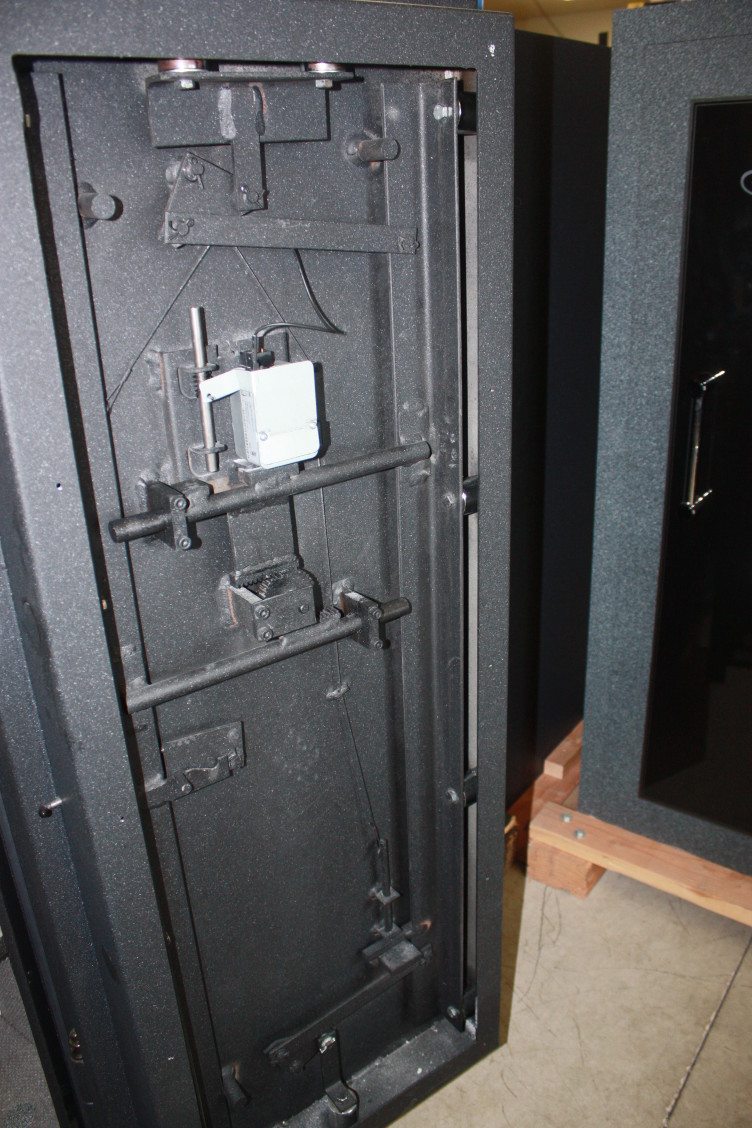
The majority of gun safes and vault doors come with cam drives. Turn the handle and the spindle transfers that motion to some kind of cam inside the door. The cam then transfers the motion to some type of linkage that moves the bolt bars in or out. Safes with cam drives are easier for burglars to open than safes with gear drives. Why, then do most gun safe manufacturers use cams? Because they make more money selling cheaper (less secure) safes. Consumers almost never see what’s inside the door of their safe, and store personnel don’t know enough to tell them. Without good information, consumers will sacrifice security for a cheaper price.

Blog, boltworks 008 Blog, boltworks 004

Besides offering better security, gear drives make for smoother operation when opening and closing the safe. On most gun safes, whether operated by cam or gear, the handle turns about one quarter to one third of a turn. I especially like the “cool factor” of a handle that spins completely around several times, like Fort Knox’ 5 to 1 rack & pinion drive mechanism.

The safe on the left with a cam drive is much less secure than the unit on right.  Both are made in American, but notice the difference in quality and craftsmanship .  It is hard to tell from the picture but the cam is assembled with press-on fasteners, and the external re-locker was installed incorrectly at the factory.

When looking to buy a gun safe, learn about all the major features – the locks, the type of insulation they use, how the insulation is mounted, how much steel there is, how the boltworks are made, etc. Buy from a place that knows the differences and is willing to show you.

Gun Safe Boltworks: Part 3

Other factors that determine how strong a gun safe or vault door is against a prying attacks include the length of the bolts, and whether pressure is deflected or distributed to parts besides the bolt bar.

Imagine a safe in which, when it is locked, the bolt bar goes right up to that part of the door which frames in the boltworks, lock, re-lockers etc. — that piece about 3” wide through which the bolts stick out. If the bolt bar fits up tight to that frame, and someone is prying on the door, then all the pressure is put right on the point where the bolt is attached to the bolt bar. That point of attachment and the bolt bar would take all the stress.

Now assume that when the gun safe is locked the bolt bar does not go right up to the frame, but stays, for example, 1” away. If someone pries on that door the frame will absorb most of the stress, at the point where the bolts come through the holes. Having a second point of contact makes a huge difference in strength. But some manufacturers use only 12 gauge steel there. Also, the size of the whole that the bolts go through can make a difference. If that hole is much bigger than the bolt itself, then the bolt has more room to move and more of the stress will be passed on to the bolt bar. It is best when the hole is just big enough for the bolt to go through, so any pressure immediately puts the bolt in contact with the frame. Naturally, thicker steel in the frame makes the whole unit stronger

BOLT BARS 017Boltworks 005

The pictures show several methods of adding strength against pry attacks. On the left, for each bolt there is a welded guide piece to keep the bolts aligned. It also acts like a spacer that keeps the bolts back from the frame about ½”, and it makes a third point of contact that absorbs pressure from prying. The bolt bar itself needs help in this safe because it is weak. Note how much of the bolt bar is cut away to reduce material cost, and the steel is only 12 gauge to begin with.

On the right is a brand of safe we sell. Notice that the frame is ½” thick! Bolts are welded to the bar, not attached with a fastener. The bar is 2” X 1/4” and is arranged in a way that yields maximum strength. Incidentally, these safe bolts are stainless steel, not plain steel.

People come to our store from all over the state because they know they will really learn about safes here.  A store or safe dealer should be willing to remove the inner door panel before you buy a gun safe, because you can learn a lot by looking inside. Don’t buy until you see what’s inside.

Gun Safe Boltworks: Part 2, Bolt Bars

The last post said that the size of the bolts in a gun safe makes no difference in a pry attack, but mentioned that there are other potential weaknesses. Flimsy bolt bars are a major problem in many safes.

BOLT BARS 001    BOLT BARS 009

The picture on the left shows the bolt bar– the vertical angle iron to which the bolts are attached — from a safe we sell.   The picture on the right shows the bolt bar from a well-known brand of gun safe that we will not sell. The safes are the same size. The bolt bar in the safe on the right is extremely weak compared to the one on the left for four reasons:

  • The one on the left is slightly longer than the one on the right.
  • The one on the left is 23% bigger: 2” x 2” vs. 1.5” x 1.75”.
  • The one on the left is 44% thicker: .1943” VS .1345”.
  • The one on the left is a solid piece of steel, while the other piece has 12 extra holes punched into it, each of which makes the piece weaker.

I believe the extra holes are there so the bolt bar can be used interchangeably in other safe models – good for manufacturing efficiency, bad for security.  Smaller dimensions and thinner steel also keep manufacturing costs down, but they’re bad for security. Take all these things together and there is a huge difference in strength.

Bent Bolts 2

So why is that important? The next picture shows a safe which uses that same flimsy bolt bar. Burglars successfully pried this safe door open.  Pressure from their pry bar caused the bolt bar to bend, which allowed the bolts to fold over enough for the door to open. This manufacturer talks about protecting your valuables, but in reality all they want to do is make more money. They make more money by going cheap on one of the most important pieces in their safes! The same principle applies  to vault doors.  This is why you need to talk with real experts when buying a gun safe, not a box store or a gun dealer who also happens to sell gun safes.

Gun Safe Boltworks: Part 1

Do bigger bolts really make a difference?

One of the biggest misconceptions relating to gun safes  is that “the bigger the bolts are, the more security you have against pry attacks”. The idea is that if someone is trying to pry open your safe, 1” bolts will break before 1 .25” bolts, and those would break before 1.5” bolts. Bigger bolts do look more impressive, but they are primarily cosmetic. Manufacturers use larger bolts to differentiate between lower priced and higher priced safes.

Consider this: If you are towing a 5000# trailer where you are stopping, starting, slamming on the breaks, etc., your whole rig is usually held together by just one 5/8” bolt in the hitch. Ever hear of that bolt breaking? So how would someone break the bolts on a gun safe or vault door, even with a long pry bar?

Bigger bolts make no difference in prying attacks – the weakness is somewhere else. The next post will tell how prying attacks DO open some gun safes.

P.S. It is appropriate to note that if someone uses power tools to cut through the edge of a safe door, then cuts completely through the safe bolts, bigger is better. But this kind of attack is extremely rare and doesn’t even make sense. Someone with that kind of tool will go through the side of the safe much quicker.